A simple trip turned into something much bigger than she expected. Years later, its impact is still reaching a group of university students as they host a 5K event May 2 in Laramie’s Washington Park.
Story By Taiye O. Idahor | Post By: Molly Walters
Nobody told Christy Bidstrup that her vacation would involve cheetahs chasing her across a savannah pen. She found that out when she was already there.
“The cheetahs would chase us,” she said, laughing like it still surprises her. “If you just saw the video without context, you would think, ‘Oh my God, you are being chased by cheetahs!’ Which was kind of cool.”
She was not in danger. She was carrying a giant pan of raw meat in the bed of a pickup truck through the Namibian dust, so the cheetahs wanted the meat, not her. And the speeding truck simulates the prey chase to keep the cheetahs fit.
That was 20 years ago.
Today, Bidstrup, a retired coin marketer from the United States Treasury Department, is sitting in Laramie, watching college students organize the Run Like a Cheetah 5K for the very animal that once sprinted at her across a field.
The University of Wyoming Communication and Journalism Department is taking a group of students to Namibia for a study abroad class at the Cheetah Conservation Fund (CCF) at the end of May. It is all because of Bidstrup.
“Because of Christy’s connections, we got to meet Dr. Laurie Marker, the founder of CCF, and give students the opportunity to work with an international nonprofit,” Cindy Price Schultz, one of the study abroad professors, said. “Her cheetah experience led to our upcoming cheetah experience!”
There are only about 7,000 cheetahs left in the wild today. A century ago, their population was estimated to be around 100,000. They now live on just 9% of the land they once roamed. Bidstrup sat with those numbers for a long time. They are part of why she never really left Namibia behind, even after she came home.
She found her way there through Earthwatch, an organization that places ordinary people inside real scientific research. She chose a trip to the Cheetah Conservation Fund and something about that place stayed with her.
The work was not romantic. At the end of long days, she would sit near the pens and watch cheetahs clean themselves like house cats, which they are not but sometimes sound like.
“I look back now and I loved every single minute of it,” she says. “Even when I had blisters on my hands and was thirsty, it was still life changing.”
One of the problems was that farmers were killing cheetahs and blaming them for livestock losses that were often caused by other predators. CCF introduced a livestock guardian dogs program, where Kangal and Anatolian Shepherds from Turkey were raised with livestock and bonded with the herds. Since 1994, CCF has placed over 600 of these dogs with Namibian farmers, 91% of whom reported a significant drop in livestock losses.
Part of what makes cheetahs so vulnerable is how they are built. They are fast, but not strong enough to fight off larger predators, so they often lose their food and have to start again. Cheetah mothers raise their cubs alone and losing most of a litter is common. That is the reality of the species.
The moment that changed Bidstrup’s life happened quietly at the farewell dinner on the last night of the trip. Marker moved through the room and stopped at each volunteer. Then she asked a simple question. “So, what are you going to do?”
Bidstrup realized the question was not about what she had done; it was about what she would do next.
“It kind of took us all off guard,” she says. “She was really holding us to account.”
Bidstrup went home to Virginia and joined the local CCF chapter. There, she organized galas, hosted fundraisers and invited guest speakers. At one point, she was part of a team that arranged for a live ambassador cheetah from the Columbus Zoo to attend CCF events in a Virginia banquet room. Over time, she became a trustee of the Cheetah Conservation Fund.
She also created a grant that sends a UW student to Namibia each year. In Summer 2025 that student was Forrest Cole, a journalism major from Wheatland. He was the first-ever communication-oriented intern at CCF.
“Forrest was excited to take pictures of cheetahs and do other things for CCF,” Price Schultz said. “Now several other students will get the same opportunity – all because Christy made that connection possible.”
This spring, students in the Price Schultz’s Public Relations Techniques course are organizing the Run (or Walk) Like a Cheetah 5K, a fundraiser for the Cheetah Conservation Fund to be held May 2 in Washington Park in Laramie. Many of them started the semester knowing very little about what is happening to cheetahs. Maddy Huffman, a communication and marketing double major from Cheyenne, is in both the PR class and the Study Abroad.
“I have always wanted to do conservation work and this class at CCF will allow me to get hands-on experience,” she said. “Through planning the Run Like a Cheetah event, I am learning that you can never be too prepared, too organized or have too much communication!”
Overall, the experience has come full circle.
“It makes me realize it was all worth it,” Bidstrup said quietly. “You touch somebody. And those people touch somebody. And you begin to make a difference.”
What she wants people to think about on the morning of the run/walk is simple. “While you are running or walking, think about a cheetah and what it has to do to survive. It has to run like the wind to catch prey. Think about a cheetah mother raising her cubs all on her own.” She paused. “Then, run like a cheetah.”
And she smiles, the way you do when you have been chased by one!
To participate in the Run (or Walk) Like a Cheetah 5K, use the link: https://runsignup.com/Race/WY/Laramie/RunOrWalkLikeACheetah. The run starts at 8:30 a.m. and the walk starts at 9:30 a.m. A silent auction of cheetah-related goods and other items will be from 9-10:30 a.m. Participants should meet at the basketball court in Washington Park.
For more information, contact Price Schultz at cprice@uwyo.edu.
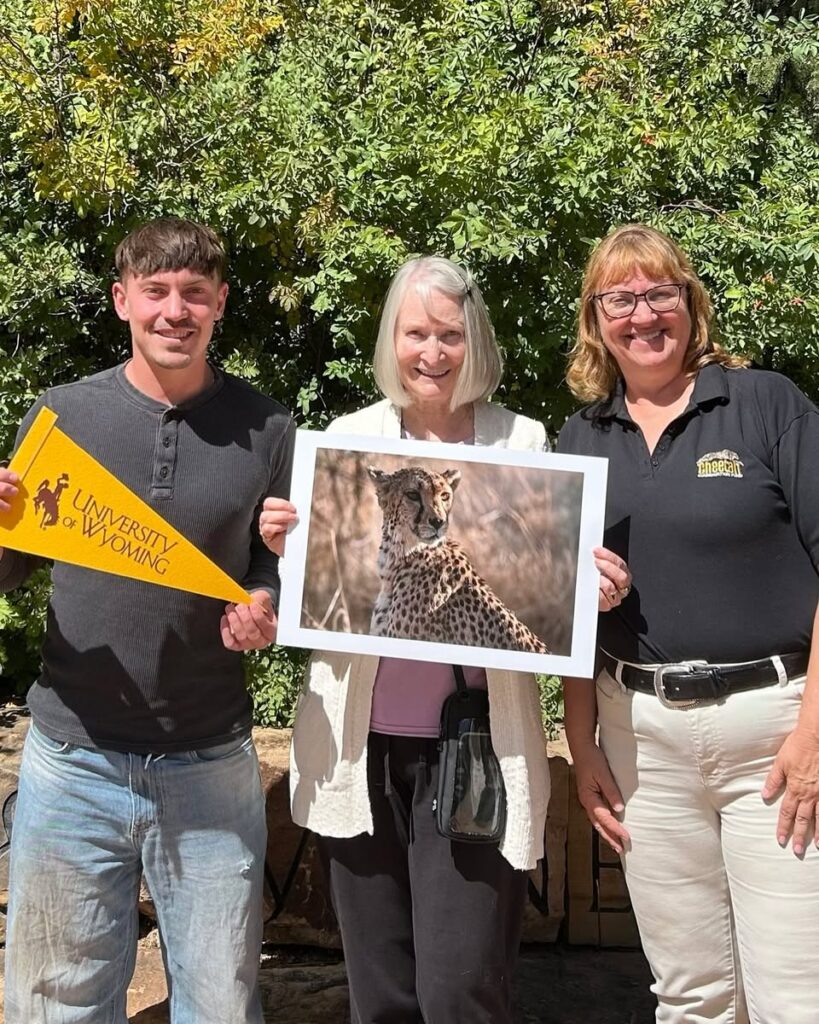
Forrest Cole, Christy Bidstrup and Cindy Price Schultz discussed the Cheetah Conservation Fund in Namibia where Bidstrup’s grant sent Cole in Summer 2025.